Showing posts with label history. Show all posts

Wednesday, July 19, 2017

The Ghost of Burt Castle


Burt Castle was built during the 16th century in Ulster at the southern edge of the Inishowen Peninsula. Inishowen had been in the hands of the O’Doherty Clan for more than a thousand years and Burt Castle was only one of several castles that dotted the peninsula. It has seen its share of conflicts, intrigue… and murder. And throughout the centuries there have been numerous ghostly sightings, even today among the ruins.


Here is how I describe the castle in Clans and Castles, the first book in the historical Checkmate series—then keep reading for the stories behind the ghostly sightings:


Burt Castle rested at the southern edge of the Inishowen Peninsula like a silent sentinel keeping watch over the O’Doherty landholdings. It was constructed during the reign of Henry VIII and was considered a more contemporary style than earlier Irish castles. Built of the same limestone and rock that was found in abundance throughout Ulster, it rose three stories above the ground and at two of its four corners stood towers that reached another two stories before giving way to parapets that afforded a spectacular view of the Irish countryside—and even Derry, which was a only a few miles away.


Each wall was between four and five feet thick, the towers dotted with perforations for dozens of harkbus, along with larger openings for cannons.


There were two more stories below ground, comprised of dungeons, an armory and soldiers’ barracks and offices, eventually giving way to a stone wall that surrounded the castle and grounds, which was in turn encircled by a mote. With Ireland’s violent history of invasion ranging from the Vikings and Normans to the Spaniards and English—not to mention battles between clans—it was a formidable fortress built to withstand assault.


During the 16th century when Burt Castle one of the O’Doherty men seduced a young girl from the neighboring area—quite possibly Derry, which was only a short distance away. The lovers met as lovers do, and the girl gave up her heart and her body to the nobleman. Soon after, she discovered she was pregnant but when she informed her lover, he absolved himself from all responsibility.


She wanted marriage and all it meant for her unborn child: legitimacy, protection and a place in the O’Doherty clan. When he refused to marry her and turned his back on her, she became increasingly distraught. Over the preceding century, Ireland had turned from its original pagan religions to Catholicism and a bastard child would create a lifetime of hell for both the mother and the child.


So on one night as the moon shone full and bright, she walked along the shore of the Lough Swilly, eventually wading in and drowning herself and her unborn child in its frigid waters.


Her father made a vow to avenge his daughter’s death and her undoing by the O’Doherty kinsman and he discovered through workers at Burt Castle exactly where her lover slept: in the vaulted, mural chamber on the first floor near the southwest tower. On one dark, lonely night when the clouds roiled and tumbled overhead, he tricked his way into the castle at the southwest tower and climbed from the ground floor to the first elevated story by way of the spiraled turnpike staircase and into the lover’s chamber where he slept.


There, the father withdrew his long knife, sharpened for the occasion of avenging his daughter’s death, and stabbed the O’Doherty kinsman repeatedly. To ensure that he was beyond resuscitation, he then dragged his body to the narrow window. Pushing it through, he tried to aim it for the craggy rocks at the base of the castle but it fell instead on a patch of grass close to the cold stone wall.


From that time forward, each time the moon is full, the ghost of a young girl is seen walking the shoreline of the Lough Swilly, her distraught wails caught on the winds and carried for miles, only fading when the figure wades into the water and disappears under the waves.


And on those nights, the swans rise up from their positions along the banks and fly to Burt Castle, where they begin wailing at the base of the old southwest tower where her lover was plunged to his death, a patch that even today grass will not grow…


Burt Castle figures prominently in Clans and Castles, the first book in the Checkmate series, and is haunted by more than one ghost… The book is a three-time award nominee: 2018 International Book Awards, 2017 USA Best Book Awards and 2017 Readers Choice Awards. Click here to read more and purchase the book with a free autograph or buy from amazon. It is also available in all fine bookstores around the world.


p.m.terrell is the internationally acclaimed author of more than 21 books, including the award-winning River Passage, award-winning series Black Swamp Mysteries and award-winning Ryan O’Clery Mystery Series. She is the Founder of Book ‘Em North Carolina Writers Conference and Book Fair and the Founder of The Novel Business. She has been a full-time author since 2002. Prior to that, she founded and operated two computer companies in the Washington, DC area with specialties in defense and intelligence. Her clients included the CIA, Secret Service and Department of Defense. For more information, visit www.pmterrell.com.

Wednesday, June 14, 2017

Derry or Londonderry?


Londonderry/Derry is the 2nd largest city in Northern Ireland, second only to Belfast yet whether it is called ‘Londonderry’ or ‘Derry’ by residents of the Republic of Ireland and Northern Ireland has a lot to do with politics, religion and heritage.


In my book, Clans and Castles, the first book in the new historical Checkmate series, I refer to the city—then a village—as Derry. The name was originally Daire—pronounced as Derry—and though it was Anglicized, the original Gaelic name meant “grove of oak trees.” Here is an excerpt from the book describing its early history:


For five hundred years, the village had basked in its wild remoteness; while the rest of Europe had been engulfed in the Dark Ages, it had remained the peaceful and picturesque site of a monastery. Saint Colmcille himself had begun it in 521. The son of an Irish princess from Leinster and a father whose family had captured Saint Patrick and brought him to Ireland as a slave, Colmcille was said to have bridged two worlds. He was a member of the O’Neill Clan, one of the largest and most powerful clans in all of Ireland, and also a devout man of God and follower of the Catholic faith yet he somehow managed to achieve respect and reverence by both the Celts and the Gaels as well.

The land had been given to him, and although the O’Neill Clan held vast territory east of Derry, the monastery was situated on the west bank at the junction of the O’Donnell and O’Doherty domains. It was, perhaps, a gift from the O’Donnells to maintain peace between the two clans, which was often a tenuous peace at best, more often than not giving way to treachery and war.

No longer a monastery, Sir Henry Docwra had set out to change its history and was now considered the founder of the spirited village that had sprung up in its place since the English had begun her colonization of Ireland. From all accounts, after a dubious beginning, Docwra had fallen in love with the country and had striven to make Derry the jewel of the island; a lively port village and bustling trading post, it was a routine stop for journeys heading further west.


As the book unfolds, Docwra—having fallen out of favor with the English monarchy—was replaced with Sir George Paulet, a man who despised the Irish and who ruled Derry with hostility and discriminatory practices. He also coveted the land to the west of the village—land that had belonged to the O’Doherty Clan for more than a thousand years and that was ruled by Cahir O’Doherty. Cahir had come to power as a mere teenager when his father passed away and he was only 23 years old at the time my ancestor, William Neely, arrived in Ulster. He had been known as “The Queen’s O’Doherty” for his loyalty to Queen Elizabeth I, and he had married an Englishwoman, Mary Preston.


Paulet was determined to drive O’Doherty off the Inishowen Peninsula and had sent troops many times to O’Doherty castles, where they attempted to establish residency. Cahir had appealed to King James I, who had issued an edict that the Inishowen Peninsula was to remain in the hands of the O’Doherty for his loyalties during the Nine Years War, but Paulet ignored it. Finally, in April of 1608, Cahir had had enough. He had been humiliated in public by Paulet, an occurrence that he considered worse than death, as he was an honored soldier and king and had been knighted in his teens by Queen Elizabeth herself.


Cahir burned all of Derry to the ground, sparing no building, and killed Paulet. It touched off O’Doherty’s Rebellion and would make Cahir the last of the Gaelic Irish Kings.


After the Rebellion, there was no money in Ireland to rebuild Derry so the settlers—English and Scots—appealed to London. Largely funded through private donations as well as the monarchy, Derry was rebuilt and in 1613 was renamed “Londonderry” to honor those in London who had funded its resurrection.


Today those with ancient Irish roots, predominantly Catholics, continue to refer to the city as Derry. Those of English and Scottish descent, predominantly Protestants, refer to the city as Londonderry. On maps, it is frequently shown as Londonderry/Derry and in typical Irish fashion it is also nicknamed “The Slash City”.


It has been the site of much strife between the Unionists (those in favor of Northern Ireland remaining part of the United Kingdom) and Loyalists (those loyal to one united Ireland). I am currently writing the second book in the Checkmate series, in which once again Derry is the site of fighting. During the 17th century, my ancestors defended it from attack during the Irish Rebellion of 1641 as well as during the Siege of Derry in 1688.


View the book trailer for the first book, Clans and Castles:


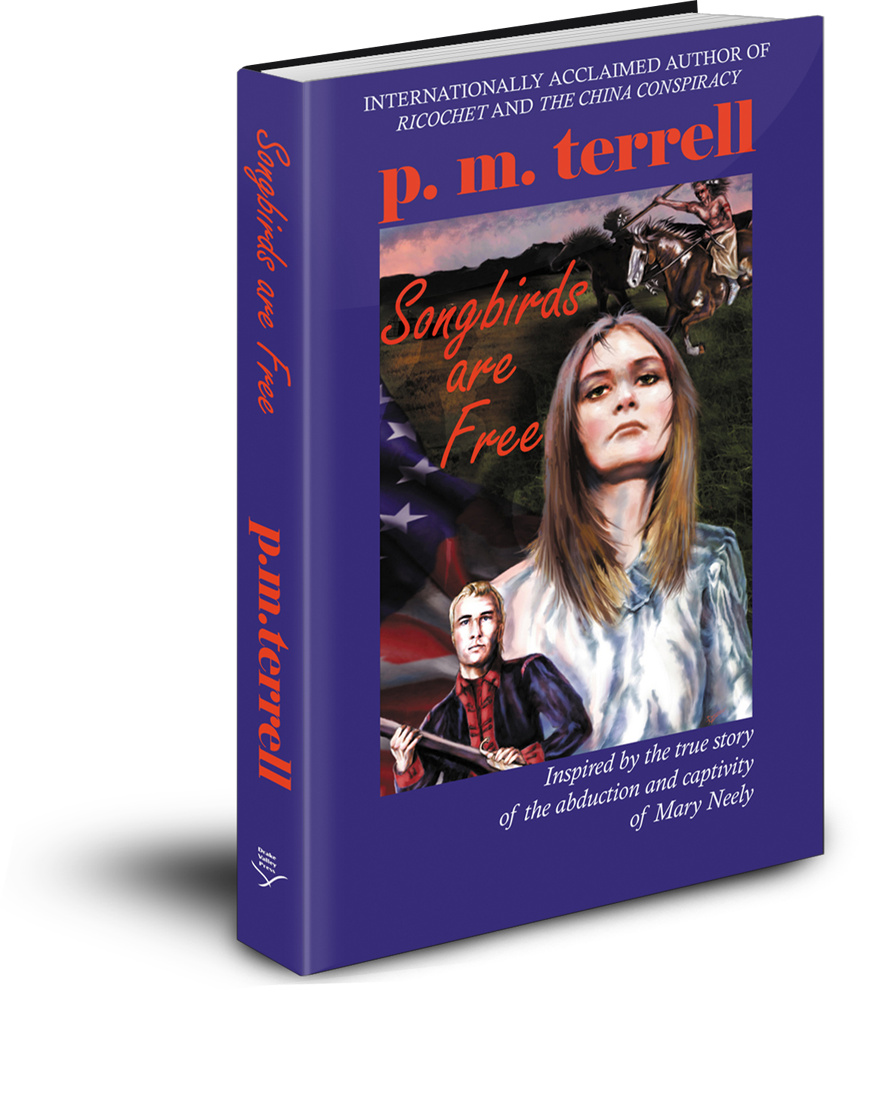
p.m.terrell is the internationally acclaimed author of more than 21 books, including her bestselling book, Songbirds are Free (the true story of Mary Neely's capture at Fort Nashborough by Shawnee warriors) and the award-winning River Passage (2010 Best Drama Award) about the Neely family's travels westward with John Donelson, as well as two award-winning series: The Black Swamp Mysteries Series and Ryan O'Clery Mysteries. She is the Founder of Book 'Em North Carolina, co-founder of The Book 'Em Foundation and the Founder of The Novel Business. For more information, visit her website at www.pmterrell.com.


Wednesday, June 7, 2017

It's a Thin Line


There’s a thin line between accuracy and the loss of credibility and nowhere does it show more dramatically than with an author. Our words are placed into the public realm for better or for worse and once credibility is lost, it can be next to impossible to regain.


This is particularly true when writing narrative nonfiction, the category that my bestselling book, Songbirdsare Free, falls within as well as the award-winning River Passage and my latest release, Checkmate: Clans and Castles. The facts must be correct but the book must also be a page-turner, increasing the suspense from the first to the last page.


With all three of these narrative non-fiction books, the ideas began by speaking to descendants of William Neely or Mary Neely. Mary’s children, grandchildren and minister had all written accounts of her ordeal that had been passed down through the generations and they varied only in minute instances; but these records were a dozen pages at most and I needed several hundred to make a full-length book. I took to the Internet, beginning with the location where she was captured and digressing into the Native American tribes in the area at that time, which ones were responsible for the vast majority of abductions and which were most likely to have brought her to Fort Detroit, where the British were paying for captured settlers. Once I established that her abductors were most likely Shawnee warriors, the places she recorded in her ordeal began to fall into place, such as Shawneetown where she was put through a ceremony and made a slave to the chieftain’s wife.


As my map became fuller with each stop along her route, I began contacting historians, archeologists and museums in each area. I made appointments to meet with each one and then took to the road, following in her footsteps. As I met with experts, they helped to fill in the gaps and often led me to meet with others in neighboring jurisdictions for additional details. By the time I returned from trips that began in Nashville, Tennessee—where a plaque is erected in her honor—through Kentucky, Illinois, Indiana, Ohio, Michigan, Canada, New York, Pennsylvania and Virginia, I had everything I needed to write the story of her Indian capture, captivity, escape and journey home.


I had so much information, in fact, that I had enough for two books. River Passage was actually easier to write because several of the people who accompanied John Donelson on his river voyage to Fort Nashborough in 1780 had kept journals, including Donelson himself. I knew on any given day where they began, where they ended and what had transpired in between. I took to the road again, following the general course of their trip—the TVA had changed the river substantially since their journey—again, meeting with historians, archeologists, museum curators and college professors to fill in the details.


With Checkmate: Clans and Castles, I thought it would be a more daunting task because all I originally had to go on was a name and a year: William Neely moved from Scotland to Ulster in 1608. How would I turn that into a book? I was to be very pleasantly surprised and in fact, intrigued by the details that came pouring forth. A Scottish friend told me once that in Scotland and Ireland a hundred miles is a great distance but a hundred years is nothing. Fortunately, I discovered a treasure trove of information dating to 1608 and even earlier.


Looking through family tree information (William Neely is my grandfather about ten generations back), I discovered that he had lived in Wigtownshire, Scotland prior to moving. I researched that area’s history in 1608 and what would have transpired that would cause an 18-year-old to leave his home and all he’d ever known to move to a country where he barely spoke their language (Irish Gaelic was a different dialect than Scottish Gaelic, though similar), where the customs were completely different and where he had no idea what to expect.


I then discovered that he had been with Captain William Stewart and that his entire life from the age of 18 until his death was spent in the northwestern corner of Ireland, largely in County Donegal. Captain Stewart was more widely known and I was able to trace his movements.


But things became really interesting when I came upon the reason both Stewart and Neely were in Ulster: O’Doherty’s Rebellion. I became immersed in Cahir O’Doherty, the last Gaelic Irish King, his English wife Mary Preston; their neighbor and sometimes-ally, sometimes-enemy, Niall Garbh O’Donnell; and the sinister, cruel Sir George Paulet, the man the English courts eventually credited with leading the Irish to rebel. I painstakingly researched Paulet as well as Sir Arthur Chichester, Henry Holt and his wife Frances, as well as the MacSweeney Gallowglass, the Inishowen Peninsula (owned entirely by the O’Doherty clan) and other clans in the region. I looked at differences between the Irish and the settlers (Scottish and English), including their religion, their loyalties, their cultures and their discrimination.


In all three of these books, I placed myself in Mary’s or William’s shoes in order to write about their thoughts, their conversations and their motivations—all of which has been lost to history. I have the distinct advantage of knowing the Neely men and Neely women (having been born a Neely) and certain characteristics, beliefs and lifestyles that have been consistent throughout the generations. I hope I have done them justice in these books. (At right, my favorite picture I took in Ireland. It was taken in a cemetery as I looked for my ancestors' graves of a neighboring potato field and a tiny white Irish cottage that had been there for centuries. My ancestors owned 1,000 acres in County Donegal at the base of the Inishowen Peninsula as well as 1,000 acres in County Tyrone, Glencull, Ballygawley.)


I once sat on an author panel with another author that claimed he had never performed one minute of research, stating proudly that every bit of his writing came from his imagination. I would have been horrified. It is in the research, the details, by which an author forms their reputation. When details are wrong or historical events are inaccurately portrayed, the author loses credibility. And when that credibility is lost, they may never get it back.


The victor writes history and in each instance, I straddled a thin line because I sought to depict not only the victor’s version but the other parties as well—the Shawnee in Songbirds are Free, the Chickamauga in River Passage and the Irish in Clans and Castles. But in the end, I believe I told each story from diverging viewpoints and I believe they will indeed stand the test of time.


p.m.terrell is the internationally acclaimed, award-winning author of more than 21 books. She is the Founder of Book 'Em North Carolina Writer's Conference and Book Fair and the Founder of The Novel Business. Read excerpts from each of her books, watch book trailers and read reviews at www.pmterrell.com.

Wednesday, May 31, 2017

Who We Are


Genealogy research is one of the most popular hobbies in America. In discovering our roots, we discover ourselves.


A few years ago when my book Songbirds are Free, the true story of Mary Neely’s capture by Shawnee warriors was released, I was contacted by a Neely descendant. She told me that when she was growing up, she always felt out of place; she never looked like anybody else and it had shaken her confidence. When she saw the picture of Mary Neely along with a police artist’s regression sketch, she felt as though she was looking at herself. It turned out that she lived in a part of the country that was heavily Hispanic and her pale Irish skin, hazel eyes, light hair and slight figure was in contrast with the olive complexions, brown eyes and hair and more robust physiques.


In learning of her Scots-Irish heritage, it opened doors for her—just as it had for me. Since that time, I have delved deeper into my family history. Scores of people spend untold hours placing names in perfect boxes to form extensive family trees, but I always wanted to go deeper. I wanted to know who my ancestors were, why they did what they did, what experiences formed their lives.


My father and brothers were deeply involved in establishing our more recent past, going back to the American Civil War and Revolutionary War. I wanted to go back even further to the time before they left for America. I wanted to know why they left all they had ever known—their culture, their language, their friends and family, to move to a country halfway around the world they had never visited and knew little about.


My quest for knowledge led me to William Neely. In 1608 at the age of eighteen, he left Scotland for Ulster, not knowing that the Neely family had lived in Ulster until the 1200’s. He was, in a sense, going home again. I wrote in Clans and Castles, the first book of the new Checkmate series, his thoughts as he sailed westward with Captain William Stewart:


But isn’t that why men leave? He thought. For a man that is content with his lot, one with standing in the community and a future laid out before him is rarely the man that leaves for the unknown. But take a man with poor prospects of employment, one with a doubtful future, and he has but two choices. He can remain where he is for the simple reason that he has always been there, and take what Life may send him; or he take his destiny into his own hands and set sail for the unknown in search of new opportunities and a brighter future.


At the time William left Wigtownshire, the Lowlands of Scotland had been deforested to the point that it was a crime to damage a sapling, a tree or even a branch. The class system had ensured that those born into nobility remained in nobility and those born with a lesser standing had little or no prospects for improvement. Sandwiched in between the English to their south and the Highlanders to their north, they were often caught in the middle of the fierce battles between the two. So it was when King James I of England offered land to Scottish Lowlanders in Ulster as part of his colonization efforts (the same efforts that landed the British on American shores), he jumped at the chance. He was searching to make his life better and in so doing, he changed the course of history for his Neely descendants.


His experience was not to be smooth, however, as the Irish continued to fight against oppressive edicts against their religion and their native birthrights. The land that was given to Captain Stewart, which was the land on which William first lived and worked, was sandwiched between the Gallowglass MacSweeneys (of Highlander and Viking stock) and the Gaelic clans of the O’Doherty, O’Donnell and more.


Going to Ulster and standing on the land my ancestors once owned was a life-changing experience for me. Looking at the cemetery situated on a hill so it would always overlook their holdings was like no other experience I’d ever had. Visiting a local historian and finding our family tree written in pencil a hundred years prior on the back of wallpaper was a memory burned into my consciousness.


I understand why many of William Neely’s descendants chose Virginia and Tennessee when they immigrated to America, for the rolling green hills must have reminded them of Ireland. My ancestors became ranchers and farmers, taking what they knew of cattle and sheep as well as farming vegetables, and creating enterprises in America that mirrored what they had built in Europe. They were tough and had to be tough to carve out lives for themselves against the Native Americans warring against them—just as they had carved out lives despite the Gaelic Irish efforts to drive them out.


In return, I’d like to think they made things better. When visiting Ballygawley, County Tyrone, Northern Ireland, I was happy to learn that William’s descendants, who had been given 1,000 acres at Ballygawley-Glencull, had donated land for the Irish Catholic church and school, despite the fact that they were Protestant. I learned that during the heated troubles between the two religions, the Neely family often hid the priests to protect them from harm.


And later, after coming to America, I learned that Mary Neely—the one that had been captured by the Shawnee and kept as a slave for three years before her escape and journey home—had learned so much about Native American medicine that people of all races traveled a hundred miles to see her and hopefully be cured by her.


Are you interested in genealogy? Have you explored not only the names and dates of your ancestors but also who they were, what they accomplished and what motivated them to do what they do? I would love to hear about it!

Read a free excerpt from Songbirds are Free, p.m.terrell's bestselling book about Mary Neely's capture, Shawnee captivity, escape and journey home. Read a free excerpt from Checkmate: Clans and Castles, based on the true story of William Neely and O'Doherty's Rebellion. p.m.terrell is the award-winning author of more than 21 books in a variety of genres, including the award-winning River Passage, the true story of the Donelson journey westward at the height of the Chickamauga Indian Wars.


Wednesday, May 17, 2017

What if you could walk in your ancestor's footsteps?


What if you could walk in your ancestor’s footsteps?


Today’s environment comes with a host of challenges, including economic recession, political drama, declining industries, a shrinking middle class, wars and threats on multiple fronts. It might be easy to come to the conclusion that living in today’s day and age poses more challenges than ever.


But what if you could take a step back in time to live as your ancestors did? What do you suppose you would find there?


I discovered a series entitled Victorian Slum House that takes modern-day families and places them in the environment of their ancestors. The day-to-day struggles are an eye-opener. Consider that during the 1870’s the average lifespan in areas of London was 28. Or the 91,000 Irish that immigrated to London in search of work, many of whom came because they had watched their own family members starve to death during the potato famine. One couple, when arriving in London, discovered lodging meant renting a coffin-shaped bed for eight hours, surrounded by dozens of others; or when the bed could not be afforded, one could sit on a wood bench with a rope that prevented falling off it during sleep for half the cost.


It may be easy to think that if we are doing well economically today, our ancestors did as well. Perhaps we have an image of our ancestors living a simpler life but having all they needed—plenty of food, a stable roof over their heads and adequate, steady employment. The reality, however, may be far from that.


When I began writing Clans and Castles, the first book in the Checkmate series, I was astounded at all I learned about Wigtownshire, Scotland in the early 17th century. The Lowlands of Scotland had become so deforested that it was a crime to cut off a branch, fell a tree or damage a sapling. Tenants often received their homes as part of their payment for work on a laird’s property, and they were moved on an annual basis. Because of that, they tended to build houses that could be erected within two days’ time and often blew away during major storms. They did not understand rudimentary agriculture such as irrigation but often thought if the land was too wet or too dry, it was simply “God’s will”.


It was that environment that my ancestor, William Neely, was born into. At the age of 18, he had the opportunity to leave Wigtownshire for Ulster—an opportunity he jumped at. In the scene below, Wills is with his friends Fergus and Tomas discussing a beautiful woman he has fallen in love with but her father doesn’t seem too keen on him:


“You have been unusually silent since you returned from dinner last eve,” Tomas said. “Things didn’t go well with the lass?”

Wills sighed. “They went well with her, aye. ‘Tis her father I am worried about.”

“What’s the story there, ‘ey?”

With the ropes secured and a short stretch of northward sail before them, Wills leaned against the railing and looked his friend in the eye for a moment. “I am afraid he could be looking for a nobleman for his daughter.”

“Ha! And didn’t we tell you?” Fergus said. “What would she want with the likes of you? More importantly, what would her da want?”

“What of your family?” Tomas pressed.

Wills shrugged. “Truth be told about it, they are tenant farmers—same as the three of us are here. Oh, and for sure, the Neely family has a decent reputation, one that has served us well. It has been a long time since our house and lands were rotated, so the house is sturdier than most and we’ve served the same laird for several generations now, we have.”

“Ah, but there’s the rub, ‘ey? Her father is looking for a nobleman for his daughter; a landowner. And a tenant farmer never owns the land himself, now does he? He tills it or he ranches it for the pleasure of the laird, and at his displeasure, he can be sent packing. ‘Ey?”

He nodded and turned to face the ocean waves. The mists were heavy this morning, the skies gray like his heart at the moment. “But though her da has lived in Donegal for two decades, at least, I had the impression his family was not of there.”

“Aye?”

“So why does a man leave all he has ever known for the wilderness of Donegal?” Without waiting for a reply, he jabbed his finger in their direction. “I’ll tell you this, I will. No man leaves home if there is something there for him.”

“Are you suggesting—?”

“I am suggesting that Varney Ó Dálaigh is a self-made man himself. See, here’s the thing: when a man is at the top of the heap, there is no reason for him to leave that. He may own lands, a manor house or a castle, even; he might have the ear of his noblemen neighbors, a place in his community. Why would he give up all of that to travel to a place so vastly different?”

Fergus and Tomas grunted but whether they approved of his logic, Wills couldn’t tell. After another moment of thought, he added, “I’d be willing to bet, I would, that he had nothing to keep him close to his family for a man does not leave home unless he sees a brighter future for himself and his children elsewhere. He brought his wife to Donegal as well, which means at the time he knew he would not likely be returning, and with his two daughters having been born in Donegal, I believe it’s safe to say that he has determined he is better off now than he was before.”

“So where does that leave you?” Tomas asked.

“Truth be told, I left Wigtownshire for the same reason, I did. I knew I was leaving. I just didn’t know when or how.”

“But that doesn’t answer the question, now does it?”

“Oh, I have an answer alright. I do. I came to Ireland to make something more of myself than I figured I could do where I was. And that I will do, or die trying. It’s just now the timetable has sped up a bit, ‘ey?”


If you could place yourself in your ancestor’s shoes, where would you be? Who would you be? How vastly different would your life be from what you are experiencing today, here, in the 21st century?


My ancestor’s life was to change dramatically when Cahir O’Doherty, the last Gaelic Irish King, launched O’Doherty’s Rebellion and he found himself fighting for King James I of England. His actions on the battlefield would set in motion not only his own fate but those of future generations. Here’s a trailer from the book:


p.m.terrell is the award-winning, internationally acclaimed author of more than 21 books, including Songbirds are Free, the true story of Mary Neely’s capture by Shawnee warriors; River Passage, the true story of John Donelson’s river journey to Fort Nashborough; the award-winning series Black Swamp Mysteries and award-winning Ryan O’Clery Mysteries, and more. A full-time writer since 2002, she founded Book‘Em North Carolina and The NovelBusiness to assist other authors and connect readers and authors. Visit www.pmterrell.com for more information.


Wednesday, May 10, 2017

Behind the Bloody Hand


While visiting my ancestral home in County Tyrone, Northern Ireland, it is impossible to escape the images of the bloody hand. It appears in various forms, sometimes with lions, a fish, a crown or a knight’s helmet. It can be found on the side of buildings, on flags, at sports complexes or in pubs. And they all tie into the O’Neill’s family crest.


I wrote about the bloody hand in my latest book, Clans and Castles, the first in the new Checkmate series of historical books about my ancestors. The scene takes place in 1608 between my ancestor, William Neely, and an Irish lady named Penarddun who had sewn the Neely family crest for him:


Penarddun slipped her long fingers under the wool and retrieved a piece of material that had quite obviously been painstakingly constructed. In the center was a castle with three turrets sewn in a grayish-black color, above which was the Red Hand of the O’Neill clan.

“Do you know what this is, lad?” she asked.

“I am afraid I do not, Lady Penarddun, though I have seen the hand.”

“Aye, and I am sure you have. It is the Bloody Hand of the Clan O’Neill. It is said that in the days of the Celts, several great chieftains sailed across the waters. They spotted the beautiful Irish coast and as their eyes fell on the magnificent shades of green, they debated who would lay claim to her. Ah, but they were powerful competitors, they were, and after great deliberation they decided they would each row a boat toward the land and whosoever touched her first would lay claim to her.”

She placed both hands on her knees, her eyes staring into the forest and yet seeing something miles and centuries apart. “So off they rowed, and it was a fierce competition, it was. The weaker ones dropped back and seeing that all was lost, they watched as two neared the shore. Oh, they were so close that none could tell who would reach it first and as the final stretch was there for the taking, Niall could not bear to lose that beautiful, precious land. So he reached to his axe and he severed his left hand at the wrist and with his right, he tossed it to shore.”

“Oh.”

She smiled. “Aye, and so Niall won, you see, for it was his hand that touched Eire first. It was in the days before we were told we needed last names… So his descendants called themselves ‘uá Niáll’ to mark themselves as the children of the champion, and it’s since been changed to O’Neill. And there you have it.”

As she handed him the material, he said, “You are too kind, Lady Penarddun. But I do not understand what the Bloody Hand of The O’Neill—”

“Your ancestors, dear boy, were descendants of Niall. You are related to the O’Neill clan.”


This was a bombshell revelation to my ancestor because O’Doherty’s Rebellion had begun. Led by the last Gaelic Irish King Cahir O’Doherty, clans that included the O’Neill, Maguire, O’Cahan, O’Donnell, MacSweeney and more united against the Scottish and English settlers, burning their settlements in an attempt to drive them out of Ulster. But Wills, who had immigrated to Ireland from Wigtownshire, Scotland in 1608, was to discover that four hundred years earlier, the Neely family had left Ireland for Scotland—which meant he had come full circle. It also meant that he would soon face off against distant relatives on more than one battlefield; one side would fight to the death to keep Ireland Irish while the other would fight for King James I of England to claim it as a colony.


The words on the Neely family crest mean “One Family, Several Countries” as the family eventually immigrated to such diverse places as Canada, the United States and Australia. Shown here is a modernized version of the family crest.


I did not know what I would find when I began to explore William Neely’s journey from Scotland to Ireland. I found much more than I could have imagined because it was a fascinating period where cultures collided; the Gaelic Irish population against the Scottish and English settlers, the Gaelic Kings against Queen Elizabeth I and then King James I, ultimately the Catholic faith against the Church of Ireland’s Protestants, betrayal… and death.


Below is a trailer:


Clans and Castles, the first book in the Checkmate series is now available on amazon in Kindle and Paperback, and will be in all bookstores on June 1. Autographed copies can also be ordered from the author’s website. p.m.terrell is the award-winning, internationally acclaimed author of more than 21 books in a variety of genres.


Wednesday, May 3, 2017

A Journey of the Scot-Irish


The odyssey into my family's history has taken me to unexpected places, and anyone of Scot-Irish (or Scotch-Irish or Scots-Irish) descent likely has ancestors that traveled a similar path. Scotland is only twenty miles or so across the Irish Sea from Ireland and the inhabitants of both countries likely sailed from one country to the other at various times. But the modern version of the Scot-Irish descendent has its roots in the 17th century and specifically between 1606 and 1652.

In the late 16th century, Spain and England were at war. And in 1588, Philip II of Spain dispatched 130 ships in a failed effort to invade England. Having been defeated at the Battle of Gravelines, the Spanish ships attempted to return home by taking a route around western Ireland when they were caught by a massive storm, blown off course and onto Ireland’s western coast. Queen Elizabeth I believed the Spaniards were attempting to occupy Ireland and she sent a substantial force to stop the invasion. With rumors that Spain was sending additional troops to assist Ulster’s Hugh O’Neill in driving out the English, the English onslaught was merciless. Around 5,000 Spanish were killed and those few that survived escaped across Ireland and the Irish Sea to Scotland and the English occupation of Ireland began in earnest.

When King James I ascended to the English thrown after Elizabeth's death, the age of colonization began in full swing. King James wanted more Protestants loyal to the English Crown in Ireland to prevent Spain from attempting another invasion and to ensure that Ireland remained an English colony. Scottish Lowlanders were encouraged to relocate to Ireland, particularly Ulster. Scottish Highlanders were forbidden from participating in the relocation because they were largely Catholic and they had been less agreeable to England (to put it mildly).

In 1608, my ancestor, William Neely of Wigtownshire, joined Captain William Stewart and moved to Donegal. Fort Stewart was eventually erected on the Lough Swilly just across the water from the Inishowen Peninsula. That Peninsula was in the firm control of Sir Cahir O'Doherty, whose family had ruled Inishowen for more than one thousand years.

In discovering my roots, I discovered the role that the Scot-Irish played in Ireland's history. Born in Scotland and migrating to Ulster, they formed Plantations similar to those in America's Deep South, consisting of potato or vegetable farms and cattle and sheep herding. The men that journeyed there were searching for a better life, as the Scottish Lowlands had been deforested and were in a bleak state in the early 17th century. However, it meant displacing the native Irish - and therein lay the conflict.

William Neely and William Stewart were to come face to face with the chieftains of powerful Gaelic Irish clans, including Cahir O'Doherty, Niall Garbh O'Donnell, Phelim MacDavitt and The MacSweeneys. And the struggle for the future of Ireland would pit the native Irish against the Lowland Scots, culminating in O'Doherty's Rebellion.

The first book in my new series, Checkmate, is entitled Clans and Castles and it begins with William Neely joining Captain Stewart in sailing to Ulster and settling in Donegal. It introduces the complexity of the relationships between the Irish chieftains and the settlers, leading to O'Doherty's Rebellion and its aftermath.

If you are a descendent of Scot-Irish heritage, this is your ancestor's story as well.

It is now available on Kindle and in other formats on Smashwords, and it will be available soon in the iBooks store, Barnes and Noble Nook and other eBook stores. The paperback officially launches on June 1. If you'd like a personalized autograph copy of Clans and Castles or any of my books, please visit my website. Free shipping!

I hope you'll join me in taking a look at our ancestors' lives and seeing them come alive through the pages. For more information, check out my website. This is the first in a new series that will take the Neely family - and the Scot-Irish - through a journey that begins in the 17th century and is on-going today. The series will cover a number of events and rebellions in Ulster eventually leading to Irish independence for the Republic of Ireland but the establishment of Northern Ireland remaining under British rule, as well as both World Wars and the migration of the Scot-Irish from Ulster to America and beyond.

Watch the short video below about Clans and Castles.


p.m.terrell is the internationally acclaimed, award-winning author of more than 20 books in various genres. Her love of Ireland is apparent in her suspense books such as The Tempest Murders, The White Devil of Dublin, Dylan's Song and Cloak and Mirrors. Her most popular book is Songbirds are Free, the true story of Mary Neely's abduction by Shawnee warriors in 1780 near Fort Nashborough (now Nashville, TN), and River Passage, the true story of the Neely family's river journey to Fort Nashborough at the height of the Chickamauga Indian Wars won the 2010 Best Drama Award.


Sunday, July 17, 2016

When History Inspires

A television series has inspired me to write another book based on my ancestors. I've become addicted to AMC's series TURN, based on the book Washington's Spies by Alexander Rose. When I fall in love with a book, a movie, a play or a television series, I always analyze it to discover what drew me in and kept me captivated. As I analyzed this show with its true story of America's first spy ring, the Culper Ring, Benedict Arnold's betrayal and all the characters that fought on both sides of the Revolutionary War, I began to consider writing another book about my own ancestors and their roles in the founding of America.

My most popular book continues to be Songbirds are Free, based on the true story of Mary Neely, who was captured by Shawnee warriors in 1780 near Fort Nashborough, now Nashville, Tennessee. And River Passage, based on the true story of the Neely family's journey westward with Donelson in 1779-1780, is an award-winning book.

Neely Family Cemetery in Ballygawley, County Tyrone, Northern Ireland
I have been interested for a long time about writing another book based on the Neely family, and when I journeyed to Ballygawley, County Tyrone, Northern Ireland, I began research on three brothers who left their home to make their fortunes in America. The year was 1720, and I found it fascinating that these brothers would leave everything they had ever known, travel for two months across the Atlantic Ocean, to a country they knew little about. Language, culture, and unrest under England's heavy colonial hand would be only a few of the obstacles they would need to overcome.

The Neely brothers were Ulster Irish, or Scot-Irish, their grandfather having come to Ballygawley from Scotland when he was granted lands in County Tyrone as reward for fighting on behalf of the King of England at Londonderry. Though technically, they were originally from Ireland, as they had lived in County Tyrone in the 16th century but lost their lands there when they fell out of favor with another monarchy.

Taken from the Bridge into Ballygawley, County Tyrone, Northern Ireland
In 1720, the brothers could have remained in a large home with servants and land holdings, but they gave it all up to travel to America.

I learned that one brother became a very successful owner of a fleet of ships that carried goods back and forth from Londonderry to York City (now New York). He also carried native Irish who were fleeing the poverty of their homeland. Though my ancestors were Protestant, they were known for their empathy toward the native Catholic population, and they had even donated land for the Catholic Church and Catholic School, so it seemed completely in character that he would take them to a new land where they could escape the restrictions imposed upon them in Ireland.

Another brother became a merchant and pub owner in York City, but he doesn't seem to have been cut from the same cloth. Racist and cruel, he drank himself to death at the age of 35.

The third brother was my great-grandfather several generations back; he would become a successful merchant and gentleman farmer, living first in Philadelphia and later in Virginia. It would be his granddaughter Mary who traveled to Fort Nashborough at the height of the Chickamauga Indian Wars, only to be captured and kept as a slave for three years by the Shawnee.

My goal is to complete this book by the end of the year. It will be considered creative nonfiction, because it is inspired by the three brothers but to make it interesting and vibrant, there are liberties taken regarding romance, suspense, intrigue - and the quest for the American Dream. Stay tuned - I'll be announcing it here when the book is scheduled for publication! [At right: Songbirds are Free, my most popular book, about Mary Neely's capture, captivity, escape and journey home in a war-torn country.]

p.m.terrell is the internationally critically acclaimed, award-winning author of more than 20 books in several genres. Visit her website at www.pmterrell.com to download free chapters of each of her books, watch the book trailers, and find out more about her writing.

Monday, June 18, 2012

Kala Ambrose - Ghosthunting North Carolina


One of the pleasures in working with Book 'Em North Carolina is meeting new authors and discovering new books. We have a wide variety of authors represented at each Book 'Em event, from non-fiction (inspirational, how-to, biographical, autobiographical) to the fiction world: mysteries, romance, horror, paranormal, drama, suspense, comedy... And I always enjoy discovering the areas in which various authors are inspired to write about.

This week, I profiled one gem in The Robesonian newspaper. Kala Ambrose is a talk show host, inspirational speaker, and a columnist for various publications, including The Huffington Post and The Examiner. She has also appeared on every major network TV: ABC, NBC and CBS and is an award-winning author.

Follow this link to read the full article as it appeared in The Robesonian on Sunday, June 17 about Ambrose's book, Ghosthunting in North Carolina. Of particular interest to me was the story about the Lost Colony of Roanoke because the Lumbee Indians in Robeson County claim their ancestors were from the Lost Colony. There are more than two dozen wonderful ghost stories in Ambrose's book. I highly recommend it.

Please make plans now to attend Book 'Em North Carolina on Saturday, February 23, 2013. Join more than 75 authors, publishers, literary agents and book promoters. Our headliners are New York Times bestselling author Mary Alice Monroe and Hollywood producer Chuck Williams! Admission is free and open to the public.