Showing posts with label Native Americans. Show all posts

Thursday, November 8, 2018

In Geography Lies Your Destiny


I have often heard the phrase “geography is destiny”. Originally a geopolitical theory that refers to certain geographic regions that carry strategic advantage, it can also be applied to the way your life unfolds, the opportunities open to you and ultimately to what you are able to achieve in life. This philosophy was brilliantly portrayed in the 2017 neo-Western murder mystery movie inspired by a true story, Wind River, starring Jeremy Renner and Elizabeth Olsen.


The story takes place on the Wind River Indian Reservation in Wyoming in the middle of winter. It is an inhospitable place, isolated from the rest of the world in a winter wonderland that can turn vicious in an instant. Early in the movie we learn the atmosphere becomes so cold that the air in the lungs can actually crystallize, leading to death. When expert tracker and U.S. Fish and Wildlife Agent Cory Lambert (played by Jeremy Renner) discovers a young woman’s body six miles from the nearest structure, he recognizes the telltale signs of pulmonary hemorrhage. The question is why she was so far from anything; tracing her footsteps, he comes to the conclusion she had been running for six miles—barefoot on ice and snow.


The Wind River Indian Reservation is a place forgotten by modern man, though it encompasses over 3,000 square miles as well as 3,500 square miles of water. It is the home of just over 26,000 Eastern Shoshone and Northern Arapaho Native Americans, descendants of people pushed onto the reservation from their original territory beginning in 1868, some 30 years after the Cherokee were relocated along the Trail of Tears to Oklahoma.


The Reservation has only a handful of people on their police force and because the FBI has jurisdiction on federal property, an agent is called in from Las Vegas when the coroner confirms the victim had been sexually assaulted. Jane Banner, played by Elizabeth Olsen, is unfamiliar with the unforgiving landscape and relies on Cory Lambert to assist her in the investigation.


The landscape itself becomes an antagonist. Regardless of the temperature in the room, you will find yourself shivering and reaching for an extra throw or blanket. The fact that Native Americans were forced to live there—and they survived—is a testament to the ability of human beings to adapt. Opportunities there are nearly non-existent; in one scene, a young man is asked why he didn’t get out when he might have been able to escape the poverty, high crime and hopelessness. One gets the sense that because these people have lived there for generations, sometimes the land itself prevents them from straying far, regardless of the opportunities that might be available to them elsewhere. It is as if their feet have roots grown deep into the frozen ground, fusing them forever to that place and time.


I admit I closed my eyes during a scene toward the end of the movie, where we learn in a flashback what occurred to the young woman and how she came to be outside in her bare feet, running for her life for six miles over ice and snow that would have stopped an average human being in their tracks long before it stopped her. By this time, the haunting landscape and the plight of its people had pervaded my spirit and long after the movie was over, I felt as if I was still there.


Missing person statistics exist for every demographic except Native American women. The life expectancy on the Wind River Indian Reservation is only 49 years and unemployment rates are more than 80%. (Bustle,2017) Though missing person statistics are not kept, Native American women are 10 times more likely to be murdered than other groups and experience rape and sexual assault at 4 times the national average. (NewYork Times, 2012)


If geography determines our destiny, it is difficult to fathom why anyone would remain in a place that appears destined to kill them—perhaps the original intent when these tribes were forced from their original territories. And yet it happens all across the globe. The invisible system that anchors us remain so strong that it is often difficult—if not impossible—to break free.


Wind River: five stars and highly recommended


Wednesday, June 7, 2017

It's a Thin Line


There’s a thin line between accuracy and the loss of credibility and nowhere does it show more dramatically than with an author. Our words are placed into the public realm for better or for worse and once credibility is lost, it can be next to impossible to regain.


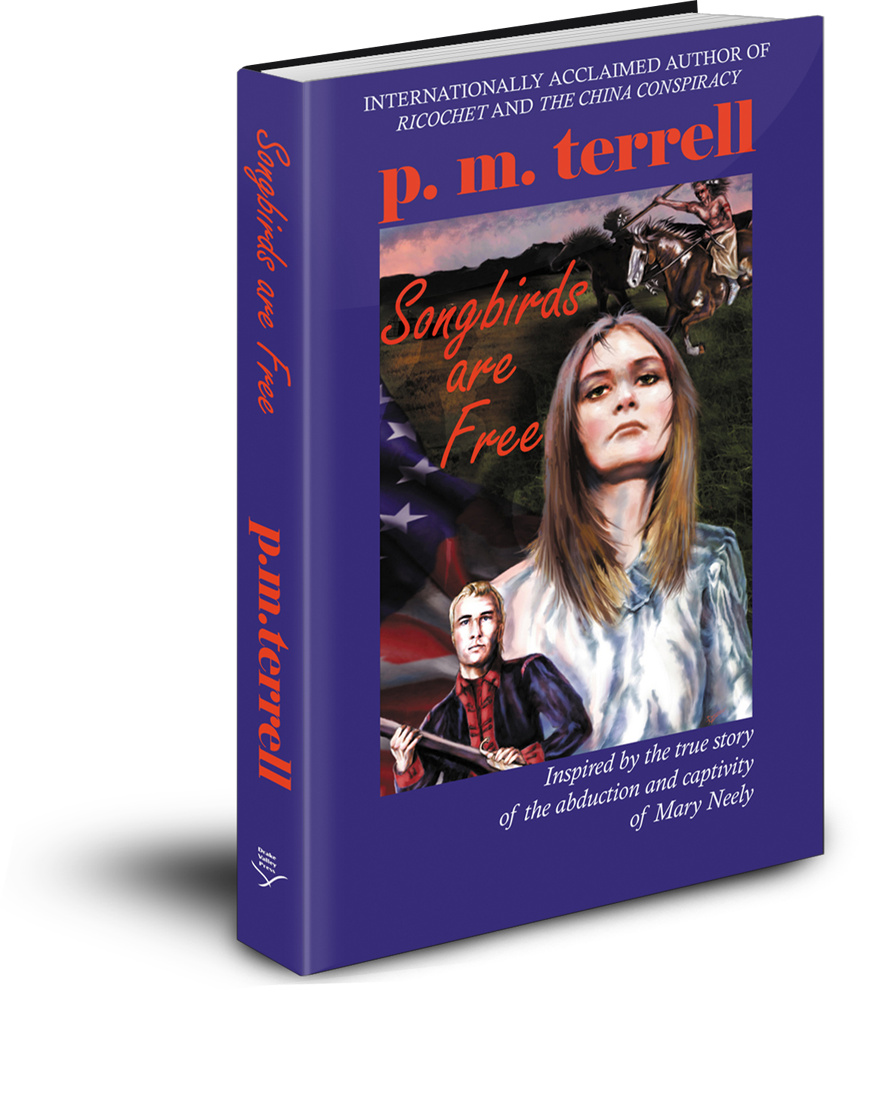
This is particularly true when writing narrative nonfiction, the category that my bestselling book, Songbirdsare Free, falls within as well as the award-winning River Passage and my latest release, Checkmate: Clans and Castles. The facts must be correct but the book must also be a page-turner, increasing the suspense from the first to the last page.


With all three of these narrative non-fiction books, the ideas began by speaking to descendants of William Neely or Mary Neely. Mary’s children, grandchildren and minister had all written accounts of her ordeal that had been passed down through the generations and they varied only in minute instances; but these records were a dozen pages at most and I needed several hundred to make a full-length book. I took to the Internet, beginning with the location where she was captured and digressing into the Native American tribes in the area at that time, which ones were responsible for the vast majority of abductions and which were most likely to have brought her to Fort Detroit, where the British were paying for captured settlers. Once I established that her abductors were most likely Shawnee warriors, the places she recorded in her ordeal began to fall into place, such as Shawneetown where she was put through a ceremony and made a slave to the chieftain’s wife.


As my map became fuller with each stop along her route, I began contacting historians, archeologists and museums in each area. I made appointments to meet with each one and then took to the road, following in her footsteps. As I met with experts, they helped to fill in the gaps and often led me to meet with others in neighboring jurisdictions for additional details. By the time I returned from trips that began in Nashville, Tennessee—where a plaque is erected in her honor—through Kentucky, Illinois, Indiana, Ohio, Michigan, Canada, New York, Pennsylvania and Virginia, I had everything I needed to write the story of her Indian capture, captivity, escape and journey home.


I had so much information, in fact, that I had enough for two books. River Passage was actually easier to write because several of the people who accompanied John Donelson on his river voyage to Fort Nashborough in 1780 had kept journals, including Donelson himself. I knew on any given day where they began, where they ended and what had transpired in between. I took to the road again, following the general course of their trip—the TVA had changed the river substantially since their journey—again, meeting with historians, archeologists, museum curators and college professors to fill in the details.


With Checkmate: Clans and Castles, I thought it would be a more daunting task because all I originally had to go on was a name and a year: William Neely moved from Scotland to Ulster in 1608. How would I turn that into a book? I was to be very pleasantly surprised and in fact, intrigued by the details that came pouring forth. A Scottish friend told me once that in Scotland and Ireland a hundred miles is a great distance but a hundred years is nothing. Fortunately, I discovered a treasure trove of information dating to 1608 and even earlier.


Looking through family tree information (William Neely is my grandfather about ten generations back), I discovered that he had lived in Wigtownshire, Scotland prior to moving. I researched that area’s history in 1608 and what would have transpired that would cause an 18-year-old to leave his home and all he’d ever known to move to a country where he barely spoke their language (Irish Gaelic was a different dialect than Scottish Gaelic, though similar), where the customs were completely different and where he had no idea what to expect.


I then discovered that he had been with Captain William Stewart and that his entire life from the age of 18 until his death was spent in the northwestern corner of Ireland, largely in County Donegal. Captain Stewart was more widely known and I was able to trace his movements.


But things became really interesting when I came upon the reason both Stewart and Neely were in Ulster: O’Doherty’s Rebellion. I became immersed in Cahir O’Doherty, the last Gaelic Irish King, his English wife Mary Preston; their neighbor and sometimes-ally, sometimes-enemy, Niall Garbh O’Donnell; and the sinister, cruel Sir George Paulet, the man the English courts eventually credited with leading the Irish to rebel. I painstakingly researched Paulet as well as Sir Arthur Chichester, Henry Holt and his wife Frances, as well as the MacSweeney Gallowglass, the Inishowen Peninsula (owned entirely by the O’Doherty clan) and other clans in the region. I looked at differences between the Irish and the settlers (Scottish and English), including their religion, their loyalties, their cultures and their discrimination.


In all three of these books, I placed myself in Mary’s or William’s shoes in order to write about their thoughts, their conversations and their motivations—all of which has been lost to history. I have the distinct advantage of knowing the Neely men and Neely women (having been born a Neely) and certain characteristics, beliefs and lifestyles that have been consistent throughout the generations. I hope I have done them justice in these books. (At right, my favorite picture I took in Ireland. It was taken in a cemetery as I looked for my ancestors' graves of a neighboring potato field and a tiny white Irish cottage that had been there for centuries. My ancestors owned 1,000 acres in County Donegal at the base of the Inishowen Peninsula as well as 1,000 acres in County Tyrone, Glencull, Ballygawley.)


I once sat on an author panel with another author that claimed he had never performed one minute of research, stating proudly that every bit of his writing came from his imagination. I would have been horrified. It is in the research, the details, by which an author forms their reputation. When details are wrong or historical events are inaccurately portrayed, the author loses credibility. And when that credibility is lost, they may never get it back.


The victor writes history and in each instance, I straddled a thin line because I sought to depict not only the victor’s version but the other parties as well—the Shawnee in Songbirds are Free, the Chickamauga in River Passage and the Irish in Clans and Castles. But in the end, I believe I told each story from diverging viewpoints and I believe they will indeed stand the test of time.


p.m.terrell is the internationally acclaimed, award-winning author of more than 21 books. She is the Founder of Book 'Em North Carolina Writer's Conference and Book Fair and the Founder of The Novel Business. Read excerpts from each of her books, watch book trailers and read reviews at www.pmterrell.com.