Watch the video below for the inside story, or skip below to read it. The video can also be viewed on YouTube at https://youtu.be/-jsmYf4osR8.
Throughout April in the Back of Beyond is another story inspired by fact. The main character, Hayley Hunter,
is a writer that is researching her family’s history, beginning with her
ancestor’s migration to Ulster from Scotland who became involved in O’Doherty’s
Rebellion.
These scenes are based on my creative nonfiction book, Checkmate: Clans and Castles, which was
released in 2017 by Drake Valley Press. In Checkmate,
my own ancestor, William Neely, arrived in Ulster with William Stewart. Their
land bordered on Cahir O’Doherty’s Inishowen Peninsula, separated only by the
lough. When Cahir set fire to Derry and began O’Doherty’s Rebellion, it would
require my ancestor to make a choice: whether to fight for King James against
the uprising or side with the Irish that had lived and ruled that region for
over a thousand years. Checkmate was
the result of years of painstaking research and I attempted to remain faithful
to the facts.
Though
the battle of Derry depicted in Checkmate
occurred in 1608, it would not be the first and far from the last. The city was
rebuilt through London private donations and renamed Londonderry. Today, more
than 400 years later, it continues to be a city divided between those loyal to
Britain and largely Protestant (unionists or loyalists) versus those fighting
for a united Ireland that are largely Catholic (republicans or nationalists).
The ideological war between the two factions was originally those loyal to
Britain versus those loyal to Ireland, but it became a religious war as well,
fueled by zealous ministers and priests. The city is often referred to as the
“slash city” Londonderry/Derry because the republican/nationalist Irish do not
recognize the name “London” in their city, it having been named Derry centuries
earlier, prior to England’s invasion.
During
the writing of this book, tensions increased in Ulster—most notably Derry and
Belfast. A journalist was killed covering a violent uprising in Derry and
several Catholic churches were burned. The increase in violence was attributed
to Brexit, which could possibly lead to checkpoints and guard posts between
Northern Ireland and the Republic of Ireland, which had unfairly targeted
Catholics in decades before the Good Friday Agreement and the removal of those
border walls.
A couple of weeks ago, I announced the release of my 23rd book, April in the Back of Beyond. In case you missed the blurb, here it is below followed by one of three true stories that inspired the book.
Writer Hayley Hunter has arrived in Ireland to complete a book
on Irish history. When she discovers the old carriage house she is renting is
haunted, she is determined to uncover the truth behind the burned ruins of a
nearby manor house and the abandoned British barracks it overlooks.
With the
assistance of Shay Macgregor, an Irish historian, her quest will take her to
1919 and the Irish War for Independence, exposing the murders of two young men
and why their mother, April Crutchley, refuses to leave the back of beyond even
in death.
With a budding romance and the opportunity to begin life anew, Hayley
finds her own life is now in jeopardy as she gets closer to a truth the
villagers have long sought to bury.
Watch the video below or at https://youtu.be/zAq9XUd4vJQ for the true story that inspired the book, or continue reading it below the video:
While
researching Irish history for a series on my Neely ancestors, I came across the
story of two teenage boys who were murdered in Ireland in 1919. Their family
had been in the country for generations and by all accounts, they were admired
and valued in their original home, but they relocated to a larger estate in
what would turn out to be a horrifically fatal mistake.
Unlike
their original home where Catholics and Protestants coexisted, their new home
was in the middle of a war zone. The Royal Irish Constabulary (RIC) and RIC
Special Forces (better known as the Black and Tans for their mismatched
uniforms) were fighting against those campaigning for Irish independence, such
as the Fenian Brotherhood and the Irish Republican Brotherhood (IRB), the
forerunner of the IRA (Irish Republican Army). Their new home, like the one
portrayed in April in the Back of Beyond, overlooked British barracks and when the two
teenage boys informed their neighbors they were not allowed to trespass on
their property, they were shot and killed and their home burned to the ground.
The
story, however, did not end there; it was only the beginning of a nightmare
that would culminate in their mother suffering from severe emotional trauma,
having tried vainly to save her sons from bleeding to death while their home
and all their possessions burned. The true attack was particularly vicious, the
shots delivered so they would suffer at least a day before dying; it was so
imprinted on my mind as I learned of it that I was unable to replicate the
savagery in April in the Back of Beyond out of respect for my readers. The information
regarding the sale of their home is accurate as well as their migration to
Australia, where the family’s descendants continue to live today.
I did not feel comfortable placing the home in my book in the same
county as the actual events took place, so literary license was used to move
the location of the house, carriage house and British barracks. Only the
barracks survive today as an abandoned property, a relic of World War I. The
names have also been changed for both the victims and the perpetrators as
descendants of both are still alive today.
Being across the ocean, I really didn’t know that much about
life in Northern Ireland during The Troubles, which stretched from 1968 to
1998, at the time events were happening. I first became aware of the deep
divisions only after I began researching my ancestry, which led to Ballygawley,
County Tyrone, Northern Ireland. During trips there, I visited Belfast and took
the bus tours which included much about The Troubles and brought me past the
Peace Walls and art commemorating both sides. In fact, one of the last British
soldiers to be killed had the same last name as my ancestors (Neely), who was
killed in an IRA bomb attack outside Ballygawley.
So when I came across the story of Jean McConville, a
38-year-old mother of 10 children who was abducted and murdered by the IRA, I
was intrigued. Who would burst into someone’s home, knowing the father had died
of cancer, and remove the mother of children as young as six years of age right
in front of them, take her to a remote location and murder her? They had to
have known the children would be left on their own, perhaps even to die without
adult care. And why would anyone be that inhumane?
Patrick Radden Keefe’s book, Say Nothing, answers those questions in a very balanced way. Being a
journalist by trade—a New Yorker Magazine
award-winning journalist—I immediately knew from the level of detail that he
had painstakingly researched not only Jean McConville and her family but also
each of the individuals that had some level of participation in her abduction
and murder. The result is an absolutely riveting story that delves deep into
what causes people to become terrorists, the changes that occur in a person’s
mind when they are raised among extreme levels of hatred and the extent to
which they will go because they believe in a cause larger than themselves.
What was particularly striking was the revelation that many
of the people involved in acts of terror—the bombing of London and Northern
Ireland and the killing of innocent civilians—suffered abnormally high rates of
drug dependency, alcoholism and PTSD after The Troubles had officially ended
with the Good Friday Peace Agreement of 1998. The agreement caused the IRA to
stand down, the British to release political prisoners held without trial or
conviction, but it fell short of turning Northern Ireland over to the Irish
Republicans. Because that was the goal of the IRA, members were left wondering
what the killing and maiming was all about if their leaders were willing to simply
give up the goal and work with the British politically through Sinn Fein.
In Jean McConville’s case—the central subject of this book—she
was a Protestant that had taken work as a domestic in a Catholic household,
subsequently falling in love with her boss’ Catholic son. In America, this
would not have been perceived as a problem at all. In Northern Ireland, it led
to the kiss of death and a generation of children traumatized by their father’s
death, their mother’s murder and their subsequent separation and hellish time
in abusive, Catholic-run children’s homes that seem right out of a Charles
Dickens novel.
Jean McConville, three of her ten children and her husband,
who died from cancer the year before she disappeared.
The investigations into Jean McConville’s disappearance
would lead to Dolours and Marian Price—it is Dolours’ picture that appears on
the front cover, her face partially hidden consistent with IRA terrorists of
the time. The damning evidence was in the form of Dolours’ own voice as she
participated in a Boston College project in which she admitted on audiotape
that she drove McConville across the border to Dundalk in the Republic of
Ireland. Later, when the men instructed to kill her did not want to do that
because McConville was a widowed mother of ten, Dolours drove back to Dundalk
with two others, assumed to be her sister Marian and Ivor Bell, and murdered
McConville, burying her in an unmarked grave. It would take decades and
particularly strong storms to erode the ground in which she’d been hastily
buried, for her body to be found. By that time, her children were grown and had
families of their own.
We do find out who fired the fatal shot that killed Jean
McConville. But the story is far larger than that. It is the story of a country
that had been invaded by foreign forces more than 700 years ago and divided in
the early 20th century so that one part of the country became the
free and independent Republic of Ireland while the other part remained a colony
controlled by Great Britain. It is the story of those loyal to the United
Kingdom as well as those carrying on a tradition of a free Ireland for which
their ancestors fought for hundreds of years. It is also the story of supposed
men of God—priests and ministers—who fueled the hatred within their
communities, leading to spiraling violence and extremism on both sides. With
Brexit, tensions have once again increased between the two factions and
ultimately, it will be London who will decide its fate.
I highly recommend this book. Be prepared for a riveting tale and a book you can’t put down.
My newest book is now available and I am super excited about it.
In April in the Back of Beyond, writer Hayley Hunter has arrived in Ireland to
complete a book on Irish history. When she discovers the old carriage
house she is renting is haunted, she is determined to uncover the truth
behind the burned ruins of a nearby manor house and the abandoned
British barracks it overlooks. With the
assistance of Shay Macgregor, an Irish historian, her quest will take
her to 1919 and the Irish War for Independence, exposing the murders of
two young men and why their mother, April Crutchley, refuses to leave
the back of beyond even in death. With a budding romance and the
opportunity to begin life anew, Hayley finds her own life is now in
jeopardy as she gets closer to a truth the villagers have long sought to
bury. Check out the quick video below:
Available in all fine book stores, you can also purchase the paperback from amazon, the Kindle eBook on amazon, and in all eBook formats at Smashwords.
Now is a great time to order one of my eBooks. Smashwords is conducting a 30% off sale on many of my most popular titles. Check out the sale at this link for a list of books, but hurry - they are only on sale for a short while!
I've been so excited about the reviews of my books throughout the years. Here are just a few:
“As a reader, you are swept along on a magic carpet of writing
wizardry.” – Syndicated Reviewer Simon Barrett
“A truly well written story that grabs your interest from page one,
teaches you a lot of fascinating history and keeps you from realizing
the passage of time as you read. Totally engrossing. I highly recommend
this read.” – Glenna Mageau, Founder of Women Writes Movement
“p.m.terrell is without doubt one of the best authors I have had the pleasure of reading.” – Fated Paranormals
“…powerfully written and masterfully suspenseful, you have to hang on for the ride of your life.” – Suspense Magazine
The House by the Lake by Ella Carey is historical
romance, mystery and in many ways, a reminder of a past that can too easily be
repeated. Watch the video below or at https://youtu.be/umxbkxOpuXU
or skip below the video to read the full review.
Max is part of the privileged, elite German class who has
fallen in love with Isabella from Paris, France. But Adolf Hitler is rising and
so is his Nazi party. There are many things about the Nazis that Max does not
like, such as their hatred of minorities, but he is willing to a certain extent
to look away from that because Hitler appears to be the only one offering
Germany a way forward from its crushing defeat of World War I. Too late, he
realizes that despite all his reservations, he will be forced to join the Nazi
party and the military as Germany begins to invade its neighbors. Not only does
his own life hang in the balance but also every member of his family’s lives
depends on his choice.
As we switch to the present day, Anna lives in San Francisco
with her aging grandfather. Max is now at the end of his life, and he has one
regret. He asks Anna to return to Germany to recover an item he’d hidden below
the floorboard. As she journeys to Old Prussia to perform what turns out to be
Max’s dying wish, she finds herself in the midst of a mystery. The village near
her grandfather’s old estate is stuck in the distant past like a ghost town and
when they discover her identity and her relationship to the estate, many become
hostile toward her. She finds a Berlin attorney willing to help her recover the
item but it places both of them on a path that will uncover secrets of the past
and change their own lives in the process.
Max’s position in the 1930s and the choices he must make
remind me all too much of the rise of current nationalism, along with its
consequences. It is well worth reading; not only is it a war-time romance
between a French woman and a German man and a personal mystery that affects
generations, but also a lesson in what happens in the early stages of a party’s
rise to power, the ability for people to look away from those aspects they
don’t like… and what happens when their eyes are opened too late.
Some books have the power to remain with the reader forever;
The Drowned Village is such a book. If there is one lesson to be learned from
this story, it is that none of us can expect to have complete control over our
lives. There is always the possibility that we will be dealt an unexpected
blow, even an undeserving one, and even the most unfortunate among us must
continue to put one foot in front of the other and make the best from what we
have left.
Stella is ten years old in 1935 as she walks the Old Corpse
Road with her father, her younger sister and a funeral procession for her
mother. The family is poor, the father cobbling together the barest of income
by making repairs to neighbors’ equipment, such as bicycles. With his wife
gone, he must support his family while also babysitting three-year-old Jessie
while Stella is at school. When his elderly father requires assistance with his
most basic of needs, he must move him into his own home and care for him as well.
Added to this weight is the news that Brackendale Green, the English village in
which they live, will be completely demolished as a newly built dam is expected
to flood the village.
Through the course of this book, we see a motherless child
forced to grow up all too swiftly as catastrophic events beyond her control
cause her to lose everything she’s ever known. She blames herself through the
decades for being unable to stop these events, despite the fact that she was
only a child when they occurred.
As we flash forward to the present day, Stella is an elderly
woman urging her grown granddaughter Laura to visit the Lake District after an
unusual drought has left the lakebed dry, exposing the village for the first
time in decades. There are secrets hidden in the ruins, secrets that have
haunted Stella for an entire lifetime and now, too frail to go herself, it is
up to Laura to uncover them and set things right. Laura is rebounding from a
disastrous relationship and needs a break from her job and caring for her
grandmother. What she will find in the drowned village will change not only her
grandmother’s life but also her own.
The Lake District with its condemned village, inspired by
the real Haweswater reservoir and Mardale Valley, comes alive. I could feel the
heaviness as Stella walked along the Old Corpse Road, could picture the variety
of characters in the village—both friend and foe—and I felt as though I had
been transported back in time. The characters are so multi-dimensional that I
realized I was intentionally slowing down my reading because I did not want the
book to end. And when it did, I found myself dreaming about Stella, her father
and her sister.
Read more book reviews at http://pmterrell.com/authors-and-books/. p.m.terrell is the award-winning, internationally acclaimed author of more than 22 books in a variety of genres.
In The Forgotten Secret by Kathleen McGurl, Clare Farrell is approaching her 50th birthday.
For half of her life she has been married to a narcissistic man who has
systematically cut her off from everything and everyone that did not center
around him. So when Clare inherits her uncle’s home in Ireland along with a
monetary inheritance, she decides to take the leap and separate from her
husband and begin life anew. The house holds secrets, including a stash of guns
and weapons under a floor in the barn and a birth certificate and communion
medallion from two separate people tucked away in the stuffing of an old
armchair.
Watch the video below or skip beneath it for the rest of the book review.
I rooted for Clare. I cheered for her, cried with her and
laughed with her. Breaking away would not be easy and she encounters events
such as wrecking her automobile on an Irish country road to renovating a
centuries-old home that has fallen into disrepair. But she makes friends in the
nearby village and she exhibits a lot of grit, determination and courage.
In between Clare’s chapters, we learn of a woman connected
to the house a century earlier during the Irish War for Independence. Ellen
O’Brien lives with her crotchety father in a modest home but she’s dating Jimmy
Gallagher, a young man she’s known an entire lifetime. They were best friends
in school and now they’ve become lovers as well as clandestine members of the
Irish underground volunteers fighting for independence from Great Britain. It
is Jimmy who grew up in the house that Clare inherits and it’s both Jimmy’s
story and Ellen’s that rolls out through the book.
The author, Kathleen McGurl, describes the countryside so
well that I could see the village in my mind’s eye, both as it was in 1920 as
well as present day. I came to respect the danger that Ellen, Jimmy and others
willingly undertook to fight for their cause—a cause that would cost some their
lives. And when Ellen discovers she is pregnant yet she is still unmarried, I
felt her anguish at being sent to one of the Magdalene Laundries, a convent for
unwed mothers and their babies that turned into an unsaintly prison.
We also see the contrasts in what women could accomplish
within a brief hundred years—at Ellen’s dependency on her father and the
kindness of strangers to Clare’s struggle for independence.
Like all of McGurl’s books, there are multiple threads that
seem unrelated but all blend together into a seamless mosaic of love and war,
endings and new beginnings. I highly recommend The Forgotten Secret by Kathleen McGurl.
I just finished reading Mary Stewart’s book, Wildfire at Midnight. The book was
originally published in 1956 and was re-released in 2011. Reading it was such a
pleasure that it reminded me why Stewart’s books landed on the New York Times and other bestseller
lists multiple times, and why many consider her to be the founder of the
romantic mystery genre. My review is contained in the video below, or you can skip the video and read the review beneath it.
Mary Stewart was born in England but she died in Scotland,
and her knowledge of the Highlands—and particularly of Skye, the book’s
setting—is apparent. I do not fish and I have never climbed and never thought I
would be interested in the details of either sport, though books on Mount
Everest are among my favorites. In Wildfire at Midnight, the
heroine—Gianetta or more commonly called Janet—is much the same. In need of a
break from her job, she heads to a resort on Skye and runs right into her
ex-husband Nicholas. Determined to remain there and enjoy her time anyway, she
is soon caught up in the tension at the resort—a tension, it turns out, to have
been brought about by a ritual murder on the mountain. It is a murder in which
the resort’s guests are each suspect—all except Janet, who arrived after it had
taken place.
We meet a wide range of characters, from cheating husbands
to unhappy wives and when two women become lost on the mountain, the suspense
ratchets up. One is found dead after her rope had been cut and the other nearly
dead several days later. Now unconscious, Roberta cannot tell the authorities
who the murderer is, and the killer makes an attempt on her again. Then another
guest is found murdered, his throat slit—and our heroine, wishing for a quiet
afternoon fishing, winds up in a fight for survival.
The action is fast, the words concise. Though it was written
in the 1950’s, the heroine is surprisingly independent and quite capable of
standing up for herself. After her divorce, she returns to a very successful
modeling career and has become somewhat of a celebrity—though in the end, in
typical 1950’s fashion, the book turns to a woman-in-jeopardy with a romantic
ending.
There are twists and turns in this book, each time causing
me to question which of the resort guests could be the killer—and it isn’t
limited only to the men. Amid the suspense are the sweeping vistas of the
mountains, the varying experience of the climbers, both the serenity and the
dangers of a land that is so enticing and yet so unforgiving.
Mary Stewart wrote around 17 romantic suspense novels in
addition to books in four other genres. If you haven’t read any of them, Wildfire at Midnight is a great
place to start.
I’d like to tell you about a book I just read
by Fran Stewart called A Wee Murder in my Shop. For the past few years there has been a
constant slate of hard-hitting news stories and sometimes it’s necessary to
escape into a different type of drama, one that is far removed from current
world events, and A Wee Murder in My Shop is just the ticket. Watch the video below or at https://youtu.be/FRDyIhvZo9o or skip below the video to read the review.
I knew I had to read this book when the author
told me that she was inspired to write it by R. A. Dick’s classic, The Ghost and Mrs. Muir. That is one of my all-time favorites, but I
always wished that Lucy Muir and Captain Gregg had been able to remain together
and form a deeper relationship. This book reminds me a lot of that but it also
brings us up to date with a more modern and independent protagonist, Peggy
Winn.
Instead of inheriting a ghost with a house as
Lucy Muir did, Peggy gets the ghost when she purchases a Scottish shawl that
turns out to be roughly 700 years old. And while the ghost is also that age,
he's frozen in time as a virile 30-something who is still deeply in love with
the woman who first owned the shawl. Now that the shawl has somehow been
resurrected after all those centuries, the ghost Peggy nicknames Dirk remains
with it as if tethered to it, following Peggy across the Atlantic to Vermont
where she owns a gift shop called The ScotShop.
Soon Peggy and Dirk are pulled into a murder
mystery. The victim is none other than Peggy's ex-boyfriend and the crime scene
is smack dab in the middle of Peggy's stop. We are introduced to a cast of
memorable characters, some of whom seem to have secrets, and we’re left
guessing who killed Mason, why, and above all, why he was killed in her shop in
the dead of night. The investigator is a modern day love throb, Harper, and I
found myself caught between wishing for a magical relationship with Dirk or a
more realistic love affair with Harper.
The author reeled me in and I could visualize
the quaint Vermont village with its Scottish theme, rows of gift shops and cozy
restaurants and steady stream of tourists—so much so, that I wish I knew if
there was truly a village the place was based on so I could visit. There are
ample clues and red herrings throughout the book, including some twists that
take us into the distant past, all woven together so expertly that I really
didn't know how the story was going to end.
The book is truly entertaining and a fun read
and escape. We don’t learn exactly why Dirk is tethered to the shawl, which
turns out to be fine because this is only the first in the ScotShop Mystery
Series. I was very happy to discover that Peggy, her ghost and her new love
interest have all been set up nicely for the sequel. It’s rather like wrapping
up some details in a television series but leaving us with a cliffhanger so
we’re eagerly looking forward to the next installment, and in fact, I can
definitely see this series made into a television series complete with the
strong, independent woman, the sexy detective and the very sexy Scottish ghost.
I highly recommend A Wee Murder in my Shop by Fran Stewart.
Visit my YouTube channel at https://www.youtube.com/user/terrellpm for more book reviews or visit my website at http://pmterrell.com/for book trailers, the inside story of my writing as well as other authors, excerpts from my books and much more.
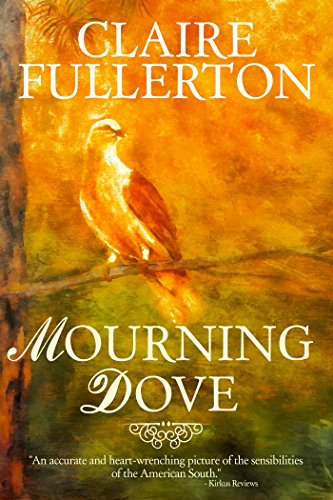
I purchased Mourning Dove by Claire Fullerton for two reasons.
First, I had read Dancing to an Irish
Reel which takes place in my favorite place—Ireland—and thoroughly enjoyed
it so I knew I enjoyed her style of writing. Second, Mourning Dove takes place in Memphis in the 1970s. I
lived for a few years during the ‘70s in the Mississippi Delta and I was curious
how the backdrop of Mourning Dovefit into my recollections of the place
and the era.
Watch the video or read my review below the video:
From the beginning, I was intrigued because the narrator of
the story, Millie Crossan, mentions that her beloved brother Finley is dead. I
found myself wondering with each twist in the journey whether that would be the
moment he dies, and it cast a bittersweet mood over the book, knowing that each
moment of his life was precious and it would be cut short way too soon.
Family dynamics come to life through a loving and caring but
alcoholic father and we view Memphis society through their socialite mother as
the parents separate and divorce and the mother remarries. Finley seems
grounded and wise beyond his years, providing stability and refuge for Millie. Music
becomes part of the backdrop as Finley joins a band and it appears that success
is imminent. And though Millie eventually graduates, gets married, miscarries
and is divorced, the book is not about her relationship with her
boyfriend/spouse or friends in Memphis as much as it is an ode to her brother
and the vital role he played in her life. They are almost like soul mates,
weaving through their own lives yet always finding their way back to the other
despite the miles that eventually separates them.
When I finished Mourning Dove, I was struck by the brevity of life and
how quickly it plays itself out. I was also reminded that regardless of the
paths we take in adulthood, our lives are truly formed by those early years. It
brought back memories for me of a different time and place, a bygone era that
seems cruel and crude in comparison with today’s enlightenment. It reminded me
just how far we have come, and how far we have yet to go.
In The Shadowy Horses by Susanna Kearsley, archeologist Verity Grey begins an
excavation in Scotland. The Ninth Roman Legion was rumored to have camped there
as they marched north from York to fight the Scots, and the owner of a remote
manor house is convinced his property contains the bones of the lost legion.
From the first night in the manor house, Verity hears the
horses thundering across the fields beneath her window, whinnying and snorting
as their hooves pound the ground. Yet when she begins her first day of work,
she discovers there are no horses within miles around.
The cook’s son has paranormal gifts that Verity vainly
attempts to logically explain away. He sees the ghost of a Roman sentinel
walking through the fields. Verity reminds him of his sister, so the phantom is
determined to remain near her, watching over her and protecting her—which
factors into the climactic scenes. The cook’s son also sees things before they
happen and occasionally is consumed by other unseen presences.
As Verity begins the excavation work, she is joined by
others including a handsome Scot named David so in addition to the ghost and
the work, she finds herself caught up in romance.
I have loved every Susanna Kearsley book I’ve read. Her beautiful style reminds me of books I read
while growing up; a modern-day Daphne du Maurier or Mary Stewart. The
characters are complex, revealing themselves one layer at a time. The setting
is described so exquisitely that I could smell the heather in the fields, the
rain moving in, the fish market in the village. I could hear the shadowy horses
thundering through the fields, I could feel the ghostly presence of one that
can never leave his last encampment. Reading any of Kearsley’s books is truly
an immersive experience.
There is a twist at the end that I didn’t see coming but in
retrospect, all the clues were there, cleverly hidden in plain sight.
I definitely give this book five stars and I’m anxious to
read another of Kearsley’s books as quickly as possible. They are addictive.
I have often heard the phrase “geography is destiny”.
Originally a geopolitical theory that refers to certain geographic regions that
carry strategic advantage, it can also be applied to the way your life unfolds,
the opportunities open to you and ultimately to what you are able to achieve in
life. This philosophy was brilliantly portrayed in the 2017 neo-Western murder
mystery movie inspired by a true story, Wind River, starring Jeremy
Renner and Elizabeth Olsen.
The story takes place on the Wind River Indian Reservation
in Wyoming in the middle of winter. It is an inhospitable place, isolated from
the rest of the world in a winter wonderland that can turn vicious in an
instant. Early in the movie we learn the atmosphere becomes so cold that the air
in the lungs can actually crystallize, leading to death. When expert tracker
and U.S. Fish and Wildlife Agent Cory Lambert (played by Jeremy Renner) discovers
a young woman’s body six miles from the nearest structure, he recognizes the
telltale signs of pulmonary hemorrhage. The question is why she was so far from
anything; tracing her footsteps, he comes to the conclusion she had been
running for six miles—barefoot on ice and snow.
The Wind River Indian Reservation is a place forgotten by
modern man, though it encompasses over 3,000 square miles as well as 3,500
square miles of water. It is the home of just over 26,000 Eastern Shoshone and
Northern Arapaho Native Americans, descendants of people pushed onto the
reservation from their original territory beginning in 1868, some 30 years
after the Cherokee were relocated along the Trail of Tears to Oklahoma.
The Reservation has only a handful of people on their police
force and because the FBI has jurisdiction on federal property, an agent is
called in from Las Vegas when the coroner confirms the victim had been sexually
assaulted. Jane Banner, played by Elizabeth Olsen, is unfamiliar with the
unforgiving landscape and relies on Cory Lambert to assist her in the investigation.
The landscape itself becomes an antagonist. Regardless of
the temperature in the room, you will find yourself shivering and reaching for
an extra throw or blanket. The fact that Native Americans were forced to live
there—and they survived—is a testament to the ability of human beings to adapt.
Opportunities there are nearly non-existent; in one scene, a young man is asked
why he didn’t get out when he might have been able to escape the poverty, high
crime and hopelessness. One gets the sense that because these people have lived
there for generations, sometimes the land itself prevents them from straying
far, regardless of the opportunities that might be available to them elsewhere.
It is as if their feet have roots grown deep into the frozen ground, fusing
them forever to that place and time.
I admit I closed my eyes during a scene toward the end of
the movie, where we learn in a flashback what occurred to the young woman and
how she came to be outside in her bare feet, running for her life for six miles
over ice and snow that would have stopped an average human being in their
tracks long before it stopped her. By this time, the haunting landscape and the plight of its people had
pervaded my spirit and long after the movie was over, I felt as if I was still
there.
Missing person statistics exist for every demographic except
Native American women. The life expectancy on the Wind River Indian Reservation
is only 49 years and unemployment rates are more than 80%. (Bustle,2017) Though missing person statistics are not kept, Native American women
are 10 times more likely to be murdered than other groups and experience rape
and sexual assault at 4 times the national average. (NewYork Times, 2012)
If geography determines our destiny, it is difficult to
fathom why anyone would remain in a place that appears destined to kill them—perhaps
the original intent when these tribes were forced from their original
territories. And yet it happens all across the globe. The invisible system that
anchors us remain so strong that it is often difficult—if not impossible—to break
free.
For nearly 20 years I have written suspense novels and
historical suspense, so it may come as a surprise—to you and to me—that I have
written my first children’s book, The Adventures of Blade and Rye.
Written for children ages 10 and under, The Adventures of Blade and Rye is written as a lyrical poem
similar to the style I loved when I was a small child and listened to my mother
reading The Cat in the Hat or The Night Before Christmas. The first
things I memorized were stanzas from those book pages, and they instilled in me
a love and appreciation for poetry.
The book is about two tiny fairies named Blade and Rye and
their adventures when they discover Planet Earth. They fall in love with the
Blue Planet and beg their teacher, Miss Indigo, to remain there to witness all
the exciting things that occur in nature. They must find the perfect home, which
takes them from mountain peaks to ocean depths. When they discover just the
right spot, they are turned into two tiny blades of grass to keep them safe
from wandering into danger. And there under the protective arms of a yew tree
beside an idyllic lake, they bask in the sunshine, witness the moon’s
appearance and discover life underground.
I have always loved angels and fairies and as I have researched
my Scots-Irish ancestry, the love and appreciation for these wee creatures have
only grown.
The official release date is November 22, 2018. Until then,
pre-orders can be placed with local bookstores for the paperback edition, which
retails for $11.99. The Kindle version is also available for pre-order at $4.99,
and amazon has jumped the gun and is selling the paperback prior to the
official release date. The book is 44 pages and full color inside and out,
illustrated beautifully by Susan Fitzgerald, who truly makes Blade and Rye come
to life.
My collie Simone passed away this week. Many of my readers
and social media followers came to know her and everyone that met her adored
her. Her picture hangs in the Robeson County (NC) Humane Society offices; the no-kill
facility that rescued her, a symbol of hope for all the dogs and cats that come
through there, a promise of a better life that is possible to all.
Her own early years were marked with abuse and neglect,
which was how she had come to Animal Control and discovered by RCHS volunteers.
I was asked to foster her; though she was about two years old and should have
weighed 75 pounds, she was barely 45 and completely traumatized. My job was to
get her well so she could be adopted out, but I fell in love with her and she
never left my home. I thought I was rescuing her, but it turns out, she was
rescuing me.
I also had two foxhounds, Mattie and Skipper. Mattie taught
her how to climb the stairs to my office so she could hang out, where the best
water was kept (in the toilet), and how to patrol the yard. Skipper taught her
where all the treats were and how to get them handed out. He cleaned her teeth
and taught Eddie, a Jack Russell adopted a year later, how to clean them as
well. She was patient as her jowls were lifted up by their muzzles while they
worked on her.
After she’d put on weight, I brought her to be spayed. It
was during surgery that the vet discovered she had given birth shortly before
she was rescued at the pound, and she’d never fully healed. She had only been
with me for a couple of months at that point and hadn’t yet figured out that
she was in her Forever Home. When I picked her up, she appeared depressed, her
head hanging, her steps slow but steady, following the leash but not really
looking up. When we arrived back home and Mattie and Skipper greeted her
enthusiastically, she sprang to life, running from room to room, jumping in
each doggie bed before rushing off to the next. It was then that she knew she
would always come back to us. She was family.
Eventually, Skipper passed away, followed a few years later
by Mattie, and Simone became Big Sister to Eddie and Lucy, another Jack Russell
adopted five years later. Her face lit up when they were near and she treated them
as if they were her own puppies that never managed to grow up.
Simone and I grew older together. We slowed down
considerably, her with arthritis and me with nerve damage, both of us favoring
one leg and unable to walk far. We both grew hard of hearing until I realized
she had to see me before she could hear me. And when she walked into a room and
suddenly stopped and looked around, I knew she was wondering what she’d come in
there for.
We had our routines; as I was getting dressed each morning,
she would come to stand by my side until I loved on her and told her she was
the most beautiful collie ever, the Claudia Schiffer of collies, and a
sweetheart, too. More often than not, she would leave the room, circle around
and come back in to hear it all over again.
She followed me to my office every morning for her dental
treat and to lie at my feet while I worked, and she followed me downstairs at
lunch and wherever I went.
Simone knew what so many humans don’t: that love and
acceptance is all that matters. Though she had been abused and neglected, she
greeted everyone that came to the house with the same silent dignity and gentle
greeting—man or woman, black or white, two legs or four. It made no difference
to her that she was black and the Jack Russells were white; she loved them
anyway and they adored her.
She had gone to the vet the week before Hurricane Florence
and gotten a clean bill of health. And earlier this week, she’d returned to
have her teeth cleaned. When she came home, she was unsteady on her feet but we’d
been told to expect that as the anesthesia took time to wear off. She laid on the
patio listening to the birds singing, eventually coming through the doggie
doors into the house, where she tried to get comfortable on the air
conditioning vent in the living room and then in front of the tower fan in the
bedroom.
I lay down beside her, telling her what a sweetheart she was
and how everybody loved her. Her head was up, her ears erect, and she seemed to
be watching something I couldn’t see. I dozed off and dreamed that she was about
3 or 4 years old and outside where Mattie and Skipper were greeting her as they
had that day so long ago. Each was asking the other where they had been before
taking off at breakneck speed to run and jump and play. When I opened my eyes,
I realized only two or three minutes had passed and when I checked on Simone,
she was gone.
Many religions believe at the moment we pass to the other
side, we are greeted by someone we know, someone that loves us, because we all
have someone we trust and love. I like to think as Simone passed, Mattie and
Skipper were truly there waiting for her, eager to show her around. They no
doubt have introduced her to Buddy, the Australian Shepherd that helped me
raise them, and to Charmer, the Old English Mastiff who was Buddy’s best friend
and “brother”. I have a feeling that my mom is telling her right now that she
is a sweetheart, and her voice so like mine, is soothing her.
But the truth is I miss her. I miss her walking into the bathroom
every morning to hear that she’s the Claudia Schiffer of collies. I miss seeing
her sleeping in her bed with all four paws in the air. I miss listening to her snoring
while I watch television. I miss hearing her paws behind me, following me
everywhere, laying down in places where I’d have to step over her, cuddling in
my arms like a true lady and then burping in my face.